

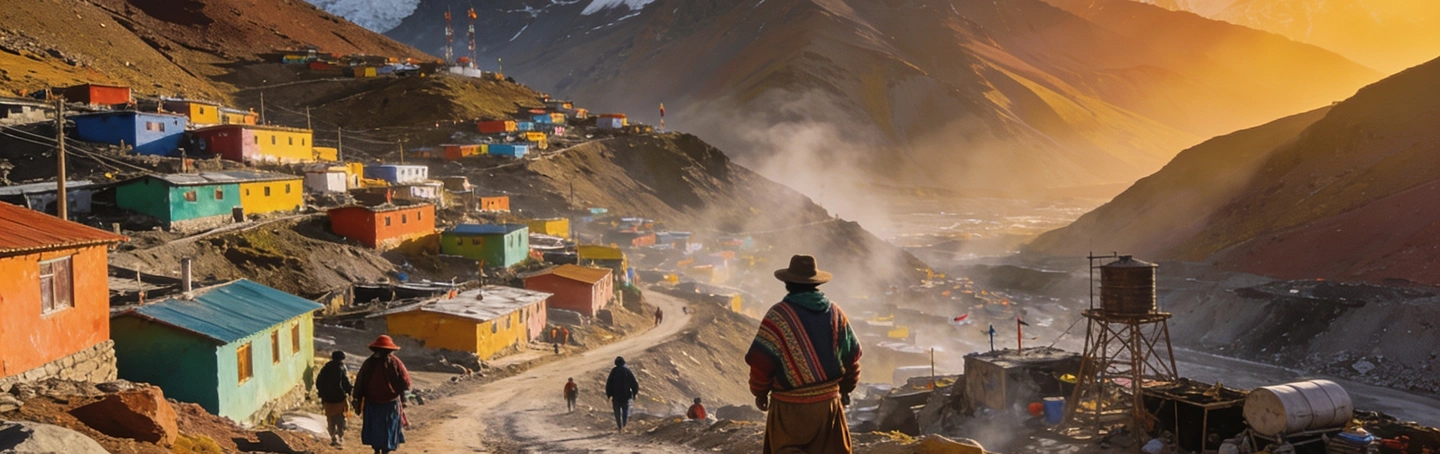
 La Rinconada: Life at the Top of the World
Mining life in La Rinconada is structured around a rhythm. Here, workers spend extended periods underground without any guaranteed pay, keeping operations running through continuous physical labor rather than immediate compensation. The outcome of that day is never consistent, as it depends entirely on where they are assigned, what section of the mountain they access, and what mineral concentration happens to be present at that moment.
Because of this structure, earnings are not directly tied to time or effort in a predictable way. Two miners may invest the same level of labor and still experience completely different results depending on placement and chance. Over time, this creates a working environment where productivity cannot be reliably converted into income and where each cycle resets the same uncertainty. What emerges is not a stable wage system but a repeated exposure to variable outcomes shaped as much by geography and allocation as by human effort. So, book your flights to La Rinconada at HolidayBreakz and experience these things in reality.
Life on the Edge of the Atmosphere
Book La Rinconada flights to a place that is 5,000 meters up. Here, people experience freezing nights and get barely enough oxygen to think straight. And still, people live here, permanently.
La Rinconada clings to the side of Mount Ananea, right next to a glacier locals call La Bella Durmiente. Flights to La Rinconada, Peru, will take you to a town spread across 4,900 to 5,100 meters and centered around 5,000. This place is also known as the highest permanent settlement on Earth. The name just means "the corner." It sits in the Ananea District, San Antonio de Putina Province, Puno Region.
Flights to LA from USA will land you at a place situated only fourteen degrees from the equator, but it feels more like Greenland's coast than anywhere tropical. People experience rain in summer, dry winters, and every day snow shows up whenever it wants. The average yearly temperature is 1.3°C.
Digging for Gold, One Month at a Time
Mining here happens two ways: legally and informally, in that gray area nobody's bothered sorting out. Gold moves from small local buyers up the chain to major international refiners eventually. Once extracted, the gold moves through a chain of buyers, from local traders up to major international refiners. One of the biggest, Metalor Technologies, a company ranked among the world's top precious metals suppliers, has come under investigation by both Peruvian and American authorities over its supply chain. In one documented case from March 2018, Metalor took in over 40 kilograms of gold worth close to $1.7 million from a company that customs officials later said they couldn't even locate at its listed address. Investigations have linked parts of this supply chain to illegal mining, harsh labor conditions, smuggling, and drug trafficking, and gold traced back through this chain has reportedly ended up in products made by major electronics companies, including Apple and Samsung.
Only one company holds an official government mining license in La Rinconada, called Corporación Ananea, and most local miners work under its cachorreo system. The setup is brutal in its simplicity: miners work thirty days without pay, and on the thirty-first day, they're allowed to keep whatever ore they can physically carry out on their shoulders. What appears to be a reward is, in reality, another uncertainty. The mountain decides more than effort does, and many workers say their designated extraction areas contain little of value, reducing an entire month's work to a gamble shaped by assignment rather than ability. Despite this, women aren't permitted to work inside the mines, but many become pallaqueras, sifting through discarded rock outside the tunnels, hoping to find scraps of value the miners missed. Human rights groups monitoring the region have described these conditions bluntly as a modern form of slavery.
Where Growth Left Essential Services Behind
Puno Province carries one of Peru's highest poverty rates, nearly 68 percent below the line. La Rinconada sits at the rough end of that number. Inca Manco Cápac International is the La Rinconada nearest airport that sits down in Juliaca, which is already sitting at a demanding 3,825 meters, where some successful miners have built second homes down there so they can breathe easily. Beyond mining, daily life in La Rinconada operates with severe limitations.
The surrounding region of Puno is among Peru’s poorest, with a large share of the population living below the poverty line. In La Rinconada itself, basic services remain incomplete or absent. Clean water access is unreliable. Sewage systems are either minimal or nonexistent. Waste management is poorly developed, leaving debris scattered across expanding settlement zones.
Power reached La Rinconada only in the past few decades, and outages are still common in parts of the settlement. Even communication and transport infrastructure struggle to keep pace with population movement.
The Lawless City
People call it "la ciudad sin ley del Perú," Peru's lawless city. Mining disputes turn violent, often. The town's reputation for sexual exploitation runs deep, including trafficking involving women and minors too. People often experience incidents on a daily basis, like gunfire, alcoholism, and prostitution.
In 2019, 68 trafficking victims were rescued from nightclubs hidden inside local slums. That same year, seven miners turned up dead in a tunnel under the mountain. Each one was shot in the head. Police estimates put illegal brothels disguised as bars somewhere between 100 and 300. Around 4,500 women, from Peru, Bolivia, and Colombia, reportedly arrived here after being lied to about the work waiting for them.
Then in 2024, Peru's government, working with the Trujillo Citizen Security Department, added 18 surveillance cameras and fifteen staffed security booths. A monitoring center now watches over all of it.
Poisoned Rivers, Thin Air
The La Rinconada altitude alone is dangerous. Researchers think at least a quarter of residents deal with hypoxia just from living this high.
Mercury makes everything worse. Miners refine gold by grinding ore, mixing in mercury, pressing it through cloth, then burning the mercury off to leave gold behind. Years of that, and both the water supply and the glacier above town have paid the price. Below the mine, water tested at pH 4.5, harshly acidic. Upstream, the untouched Pataqueña River tested at pH 8, clean. One longtime miner put it bluntly: the rain itself, up here, carries mercury.
A local farmer described his herd collapsing after the mine expanded in 2006. Eighty alpacas and 56 sheep, down to just 10 of each by 2022. And the damage doesn't stay put. It follows the Coata River all the way toward Lake Titicaca, hitting towns like Carata and Juliaca along the way. Testing in Carata, back in 2018, found heavy metals in over 83.5 percent of residents checked. One farmer talked about miles of shoreline covered in trash and dead animals. Soil across the region's too damaged now to farm.
What the Dust Leaves Behind
Even breathing carries risk here. Dr. Nelson Hugo Gadea Vargas, chief medical officer for La Rinconada and neighboring La Ananea, has described miners walking into tunnels with nothing but a wet cloth over their faces. Barely a filter, he says. Many of those miners eventually died from silicosis, a lung disease that comes from years of breathing in silica dust.
During autopsies he performed himself, he found signs of silicosis in roughly 50 to 60 percent of bodies. Just over half. That number, maybe more than anything else here, says exactly what this town costs the people who live inside it, one unpaid month, one uncertain day, at a time.


